Posts

Carl Sagan on the best stance regarding the future
Image
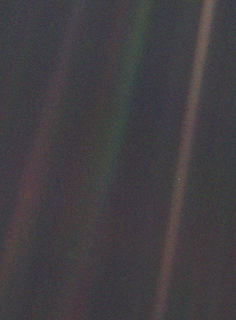
From this distant vantage point, the Earth might not seem of any particular interest. But for us, it's different. Consider again that dot. That's here. That's home. That's us. On it everyone you love, everyone you know, everyone you ever heard of, every human being who ever was, lived out their lives. The aggregate of our joy and suffering, thousands of confident religions, ideologies, and economic doctrines, every hunter and forager, every hero and coward, every creator and destroyer of civilization, every king and peasant, every young couple in love, every mother and father, hopeful child, inventor and explorer, every teacher of morals, every corrupt politician, every "superstar," every "supreme leader," every saint and sinner in the history of our species lived there – on a mote of dust suspended in a sunbeam. The Earth is a very small stage in a vast cosmic arena. Think of the rivers of blood spilled by all those generals and emperors so ...

Reading the beginning of Coetzee's The Lives of Animals

"We-even in Australia-belong to a civilization deeply rooted in Greek and Judeo-Christian religious thought.  We may not, all of us, believe in pollution, we may not believe in sin, but we do believe in their psychic correlates.  We accept without question that the psyche (or soul) touched with guilty knowledge cannot be well. We do not accept that people with crimes on their conscience can be healthy and happy. We look (or used to look) askance at Germans of a certain generation because they are, in a sense, polluted; in the very signs of their normality (their healthy appetites, their hearty laughter) we see proof of how deeply seated pollution is in them" - p. 21 "I want to find a way of speaking to fellow human beings that will be cool rather than heated, philosophical rather than polemical, that will bring enlightenment rather than seeking to divide us into the righteous and the sinners, the saved and the damned, the sheep and the goats." - p. 22 (on the sam...

The wisdom of Jefferson

How fitting.  Reposted from monticello.org: Quotations on Idleness 1787 March 21. (to Martha Jefferson Randolph ). "Of all the cankers of human happiness, none corrodes it with so silent, yet so baneful a tooth, as indolence. Body and mind both unemployed, our being becomes a burthen and every object about us loathsome, even the dearest, Idleness begets ennui, ennui the hypochondria, and that a diseased body. No laborious person was ever hysterical. Exercise and application produce order in our affairs, health of body, chearfulness of mind, and these make us precious to our friends. It is while we are young that the habit of industry is formed. If not then, it never is afterwards. The fortune of our lives therefore depends on employing well the short period of youth. If at any moment, my dear, you catch yourself in idleness, start from it as you would from a precipice of a gulph. You are not to consider yourself unemployed while taking exercise." 1787 May...

David Simon gives a talk at Princeton

http://www.princeton.edu/WebMedia/flash/lectures/20110920_david_simon.shtml

Iñarritu's movies are more realistic than they seem...

An incident in Central California last week was so bizarre that the headlines it generated wouldn't be out of place in a supermarket tabloid next to tales of alien babies and Elvis sightings: "Man Killed by Rooster." More specifically, one of the feathered contestants in an illegal cockfight in Tulare County, armed with a blade attached to its leg, apparently stabbed 35-year-old Jose Luis Ochoa in the calf, and Ochoa was declared dead of "sharp force injury" two hours later. This isn't the first time someone has died in what is supposed to be blood sport for birds; last summer in Merced, two men got into an argument over a $10 bet, one pulled out a gun and killed the other, and the victim's brother and another man allegedly beat the shooter to death. But aside from the question of whether cockfights are humane for humans, they raise serious concerns about whether the state of California is doing enough to discourage them.

Gauss

Image
The doctoral dissertation (1799) of Gauss contained a proof of the ”fundamental theorem of algebra” which states that every complex non-constant polynomial in one variable has at least one complex root. In 1807 Gauss became a professor at Gottingen University. When planetoid Ceres was discovered on January 1st, 1801, Gauss was able to compute its orbit from only a few observations. On December 31st of the same year, Ceres showed up again, exactly where Gauss had predicted. Gauss had used ”least-squares” prediction which is based on the assumption that the observation errors were normally distributed. Gauss invented modular arithmetic in 1801, and in 1831 introduced the term ”complex number”. Together with Wilhelm Weber, Gauss constructed the electromagnetic telegraph in 1834.

Etymological Tidbits

From a list I've been compiling little by little for the past 4 years (mostly from two different Word of the Day sources: dictionary.com and mirriam-webster online) Chatoyant's poetic origin lies in the French chatoyer , "to gleam like a cat's eyes," from the French chat , "cat." Before the standardization of writing from left to right, ancient Greek inscribers once used a style called " boustrophedon ," a word meaning literally "turning like oxen in plowing." When they came to the end of a line, the ancient Greeks simply started the next line immediately below the last letter, writing the letters and words in the opposite direction, and thus following the analogy of oxen plowing left to right, then right to left. "Reverse boustrophedon" writing has also been found in which the inscribers turned the document 180 degrees before starting a new line so that the words are always read left to right with every half tur...